


Foil Roll Cutter
What is Foil Roll Cutter
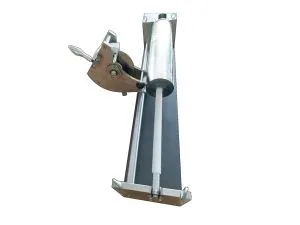
A foil roll cutter is a handy tool that can cut down the width of your foil rolls to create shorter ones. This is an essential tool for print shops and other corporations that use a foil fusing machine that requires a shorter width than the compatible foil rolls. Most foil fusing machines, including all of the Therm-O-type models that we offer, will accept only 1" core foil rolls, which are 24" long or sometimes even longer. Depending on the foil fusing machine that you have, you might only be able to accept a 12" wide roll. This is where a foil roll cutter comes into play; use it to trim that roll down, cutting through the entirety of foil as well as the core to turn your single 24" roll into multiple smaller rolls.
Foil Roll Cutter




Benefits of Foil Roll Cutter
High accuracy
The Foil Roll Cutter adopts high-tech controller and servo system, which can effectively improve the cutting accuracy.
Fast cutting speed
The Foil Roll Cutter adopts a high-speed motor and advanced cutting technology, which can quickly cut aluminum foil in a short time.
Easy to operate
The Foil Roll Cutter is easy to operate. The operator only needs to make simple settings on the equipment to complete the cutting task.
Convenient maintenance
The maintenance of the aluminum foil cutting machine is very convenient, which can effectively extend the service life of the equipment.
Food packaging industry
Aluminum foil bags need to be precisely cut to the required length and width for easy storage and transportation.
Pharmaceutical packaging industry
Aluminum foil is used to make pharmaceutical packaging materials, which requires precision cutting technology to ensure product quality.
Tobacco packaging industry
Aluminum foil is often used for tobacco packaging, and the cutting machine can efficiently cut it into the required size.
Cosmetic packaging industry
Cosmetic packaging made of aluminum foil requires high-precision cutting technology.
Other industries
The aluminum foil cutting machine is also suitable for other industries that require precise cutting of aluminum foil.
Working principle of Foil Roll Cutter
The aluminum foil cutting machine consists of upper and lower axes, which can control the cutting direction and length. The cutting shaft transmission system includes motor, reducer, transmission shaft, cutterhead, blade and other parts. Among them, the motor transmits the motion to the reducer, decelerates it and then transmits it to the transmission shaft, which then drives the cutterhead to rotate. During the rotation of the cutterhead, the aluminum foil is cut to the required length. In addition, the cutting machine also uses a PLC controller and servo system, which can help the cutting machine cut more accurately, greatly improving production efficiency and product quality.
Components of Foil Roll Cutter
Machine Bed
The main function of machine bed is support all the parts working. The range of load-bearing ability is between 800kg to 1500kg. Its own weight is able to ensure the machine's stability.
Laser source
A device for generating a laser beam source. For the laser source of XT Laser, we use IPG, Raycus, and Nlight. Sometimes we also provide other brands' laser source. The machine power we have 500 watt and above. Those laser source we use is the mainstream laser source you can find in this market.
Cutting head
Mainly include part like cutting head body, focus lens, protective mirrors, capacitance type sensor Auxiliary gas nozzles and other parts. The cutting head drive device is used to drive the cutting head alone Z axis according to the program. It is composed of servo motor and transmission parts such as ball screw or gear.
Driving system
The machine's move is through the fit of control system and machine. Control system give the servo motor to produce the kinetic energy, the X,Y and Z axis are moved by kinetic energy. By the rail guide and rack, machine will move on X and Y axis. For Z axis, the cutting head up and down by screw rod. We also put reducer under the servo motor. In this way, the reducer could protect this machine run well.
Cutting Materials for Foil Roll Cutting Machines
Cutting Copper Foil
Copper must be one of the most challenging materials to slit or cut. In itself the copper is a very soft foil. It means that it deforms, stretches and moves if it is not fixed enough. Similar to slitting aluminium, copper bends and tweaks. A too sharp blade may cut partial cuts or create tearing as the copper foil approaches the knife. In Gemba we have found that cutting copper foil also requires a less sharp knife.
Cutting Coated Copper
Cutting coated metallic foil like carbon coated battery copper foil is an even tougher challenge. It is our findings that the soft metallic foil is smooth and slippery, while the carbon coating is hard and easily cracks or generates clips or burrs. To cut such a battery-grade copper foil you need two almost 90 degrees flat knives to keep the film in position. Think more like punching than sharp blades for cutting. We have seen that a too sharp second knife has problems cutting the film and the applied coating ends up in flakes, burr or etc. But a well designed almost 90 degrees vertical knife does the job beautifully.
Cutting Laminated Metallic Foil
Similar to coated metallic foil, a laminated foil presents challenges when being cut. Depending on the layer structure and the type of layers we have found that there are two different approaches to laminated foils. Firstly, if any layer is supportive enough fixing the material foil you can proceed more like cutting a film with a sharp knife. But if the laminated layers are ”all metallic” you need to cut the laminated metallic foil just like the coated. More punching than normal slitting. Use two almost 90 degree knives.
How to Choose Foil Roll Cutter
Comparison of energy consumption
In addition to the above comparison, foil roll cutting machines of the same model also need to be compared in terms of the power used by the entire machine, because the size of the motor power is not only a matter of power consumption. Due to the precision fit of the paper roll cutting machine during the manufacturing and assembly process, it is necessary to choose a larger power motor. This is actually a solution that cannot be solved during the mechanical processing and assembly process.
Mechanical structure
The early mechanical foil roll cutting machines used spring pressure to press the paper and a slider structure to push the paper. The structure is simple and easy to debug and maintain, but the paper pressure is low and the cutting accuracy is poor. It cannot meet the requirements of high-end printing for paper cutting accuracy and cannot meet the requirements of mid-to-high-end packaging and printing products.
Use security
Foil roll cutting machine is different from other mechanical products. It is a Class 4 hazardous machine tool with a higher hazard level. Safety is the primary issue during the selection and use of paper roll cutting machines. Therefore, when choosing a paper roll cutting machine, you must focus on its safety and reliability.
Process Of Foil Roll Cutter
Take up
The aluminum foil slitting machine loads the aluminum foil roll into the machine automatically or manually, and adjusts the tension of the roll through the tension control system to keep it stable.
Expand
After the aluminum foil roll passes through the relaxing device, it enters the unfolding device. The edge of the roll is unfolded through the tension adjustment system and remains stable.
Position
The unfolded aluminum foil roll passes through the tension guide device, which positions the roll to the cutting position by adjusting the speed and tension of the conveyor belt.
Cutting
After the aluminum foil roll is positioned at the cutting position, the cutter system starts to work. Usually a round knife or a combination of multiple knives is used for cutting. The aluminum foil roll is cut by a knife system and divided into required aluminum foil strips with specific width and length.
Winding
The cut aluminum foil strips are rolled up through the winding device to become finished aluminum foil rolls or aluminum foil strips. The winding device can adjust the tension of the roll to maintain the tightness and flatness of the roll.
Clean
Before using the foil roll cutter, the equipment first needs to be cleaned. Since the foil roll cutting machine will produce a large amount of metal shavings, grease, dust and other dirt during use, if not cleaned in time, it will affect the normal operation of the equipment and even cause equipment failure. Therefore, the shell, base, cutting table, slide rails, guide rails and other parts of the equipment need to be cleaned regularly to ensure the cleanliness and hygiene of the equipment.
Lubricating
Many parts of the foil roll cutting machine need to be lubricated, which can reduce friction between parts to improve the operating efficiency and life of the equipment. However, you need to pay attention to the following points before lubrication: Choose the correct lubricating oil: The lubricating oil used in different parts may be different, and you need to choose the appropriate lubricating oil according to the different parts. Choose the correct lubrication method: Some parts need to use drops Oil lubrication, while some parts require oil injection lubrication, which needs to be selected according to the requirements of different parts.
Replace worn parts
Some parts of the foil roll cutting machine, such as blades, guide rails, etc., will wear out due to long-term use and need to be replaced in time. Otherwise, the efficiency of the equipment will be reduced and even cause safety hazards. Therefore, it is necessary to regularly check key parts of the equipment during use and replace worn parts in a timely manner.
Safe to use
Ensure operators understand operating procedures and equipment safety performance. Regularly check the safety protection devices of equipment and strengthen maintenance. For equipment faults and hidden dangers discovered, report for repair or replace parts in a timely manner, and no forced operation is allowed.
Our Factory
We are the only and best Chinese manufacturer who is devoted to producing slitter rewinder for hot stamping foils and cold foils. Our foil slitter rewinder has been exported to world top hot stamping foil manufacturers and converters, as like from: Germany, UK, Italy, France, Spain, Portugal, Holland, Switzerland, Poland, Russia, Israel, Iran, UAE, USA, Canada, Brazil, Argentina, Chile, Mexico, Colombia, Thailand, India, Indonesia, Algeria etc. Based on our plenty production experiences and feedback from customers' machine operators, our hot stamping foil slitter rewinders are optimized to cut perfect foil rolls.

FAQ
HANSOAR is one of the leading China foil roll cutter manufacturers and suppliers, exporting cheap price foil roll cutter to USA, Mexico, Colombia, Costa Rica, South Africa etc. Welcome to contact our factory for details.
Hot Stamping Foil Roll Cutting Machine, Foil Cutter, hot stampig foil cutter